


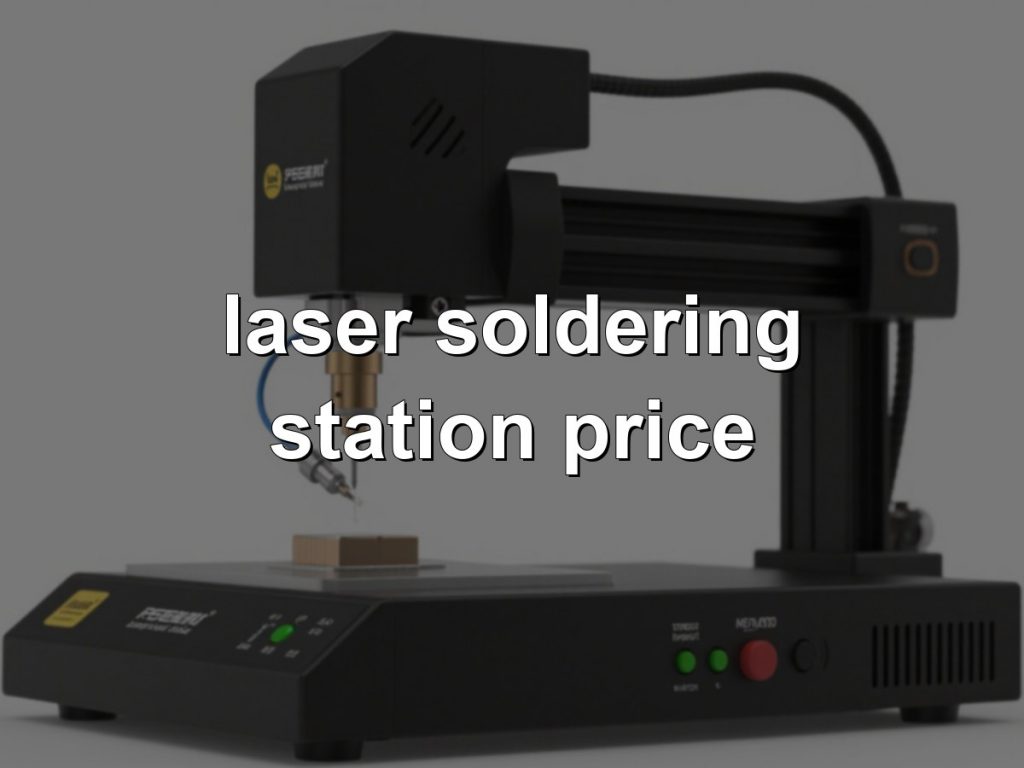
A laser soldering station typically costs between about US$8,000 and US$180,000, with benchtop single-head units for prototyping and low-volume production starting near US$8,000–20,000, and inline automated cells with CC…
A laser soldering station typically costs between about US$8,000 and US$180,000, with benchtop single-head units for prototyping and low-volume production starting near US$8,000–20,000, and inline automated cells with CCD alignment, closed-loop temperature control and post-solder AOI landing in the US$70,000–180,000 band. The laser soldering station price is driven far less by the laser wattage than by four other subsystems — solder feeding, vision alignment, closed-loop thermal control and the level of automation — which is why two machines rated at the same 50 W can differ by a factor of three. This breakdown is written for engineers who need to budget, compare quotes and spot where a supplier has trimmed cost.
What actually drives the price of a laser soldering station?
Ask any supplier for a cost breakdown and you will normally see roughly this distribution. Use it as a sanity check when a quote looks unusually low — the savings almost always come out of one of the middle rows.
| Subsystem | Share of total price | What separates cheap from expensive |
|---|---|---|
| Laser source, optics and delivery fiber | 20–30% | Diode vs fiber source, beam quality, measured spot size at the workpiece, collimation and focus optics |
| Motion platform and controller | 15–25% | 2-axis stepper vs 3–4-axis servo with linear scales, repeatability below ±10 µm, vibration damping |
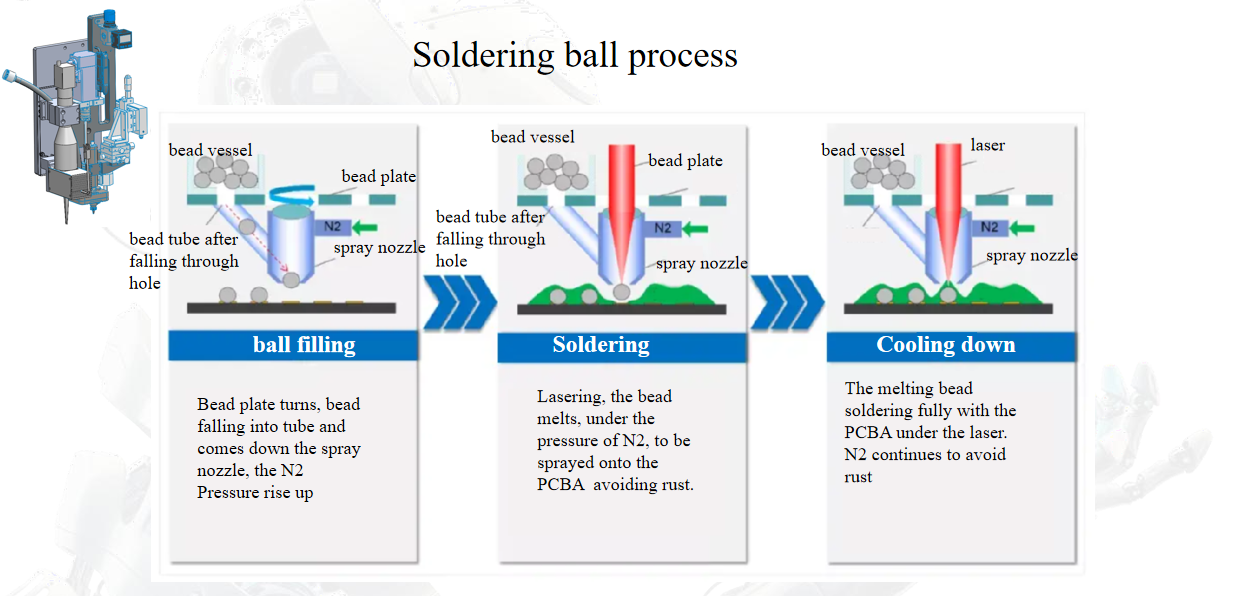
| Solder feeding (ball / wire / paste) | 10–20% | Ball size range and placement accuracy, wire diameter resolution, paste dispensing with closed-loop volume |
| Vision and AOI | 15–25% | Coaxial CCD alignment, fiducial recognition, post-solder fillet inspection, defect library size |
| Software, HMI, traceability | 5–10% | Recipe management, per-joint temperature logging, MES/SECS-GEM interface, audit trail |
| Enclosure, safety, cooling | 5–10% | Class 1 interlocked housing, fume extraction, chiller vs air cooling |
How much do the three common configurations cost?
Most buyers are choosing between a benchtop station, a semi-automatic cell and a full inline system. The price bands below are ballpark figures for 2025 and vary with region, currency, options and order volume.
| Configuration | Typical price band (USD) | What you get | Best fit |
|---|---|---|---|
| Benchtop manual station | ~8,000–20,000 | 30–60 W diode laser, manual or single-axis Z, wire or paste feed, pyrometer feedback, no vision | Prototyping, rework, runs under ~500 joints/day |
| Semi-automatic cell with vision | ~25,000–55,000 | Motorised XY + Z, coaxial CCD with fiducial alignment, multi-step temperature profiles, recipe storage, nitrogen option | Medium-volume automotive sensor and connector lines |
| Inline automated system | ~70,000–180,000 | SMEMA conveyor, 2–4 soldering heads, ball or paste feeding, in-line AOI, barcode traceability, MES link | ECU, camera module and semiconductor package assembly |
| Custom multi-head line | US$200,000 and above | Multiple laser heads sharing one platform, preheat station, full IQ/OQ/PQ validation documentation | High-volume production with regulated documentation needs |
Laser source and closed-loop control: where the price difference hides
Two suppliers can quote the same 50 W and deliver very different process capability. Insist on these measured values, not catalogue ones:
- Wavelength and source type. 808/915/980 nm diode lasers are the standard for solder reflow because solder absorbs them well and the modules are inexpensive to replace; 1064/1070 nm fiber sources cost more and are chosen when you need tighter focus over a longer working distance or fiber delivery to a remote head.
- Power at the workpiece. A “60 W” laser may deliver 45 W after fiber and optic losses. Ask for a measured value with a power meter at the focal plane.
- Spot size and focus. Typical production spots run 0.3–3 mm. A 0.3 mm spot needs better optics and better motion accuracy than a 2 mm spot, and costs more.
- Ramp rate and control loop. Usable heating rates are roughly 50–150 °C/s. A pyrometer sampling at 1 kHz or faster with ±5–10 °C closed-loop control is what prevents cold joints on heat-sinking parts. A 10 Hz loop is a false economy on thermal-mass-sensitive assemblies.
If a supplier cannot show you a measured temperature profile on your own sample, the price is not comparable to one who can.
Which options earn their price — and which you can skip
Pay for: coaxial CCD alignment (removes fixture cost and scrap from misalignment), a genuine closed-loop pyrometer, and a solder feed that matches your joint volume — solder ball for fine-pitch and BGA rework, wire for through-hole and connector pins, paste for dispensed deposits. Add nitrogen assist (target O₂ below 1,000 ppm at the joint) if you are soldering with no-clean flux on oxidized pads.
Question carefully: oversized laser power you will never use; six-axis robots on planar parts; oversized AOI packages if your defect rate is already low; and per-seat software licences that multiply as you add stations.
Do not negotiate away: safety interlocks and fume extraction. Retrofitting a Class 1 enclosure later usually costs more than specifying it.
What is usually missing from a laser soldering station quote
The purchase price is rarely the total cost of ownership. Budget for these separately, and ask each supplier which items are included:
- Fixtures and nozzles: US$2,000–15,000 for custom tooling on a new product, plus spare feed tubes and protective window glass as consumables.
- Utilities: chiller, clean dry air, nitrogen supply and exhaust. A nitrogen generator alone can exceed US$10,000.
- Process development: recipe creation, design of experiments and operator training — often 1–3 weeks of engineering time.
- Validation documentation: IQ/OQ/PQ packages for medical or automotive customers add cost and lead time.
- Freight, duty, installation and extended warranty, plus software maintenance renewals.
As a planning rule, budget 3–7% of the capital price per year for consumables, spares and service. For an illustrative total-cost check: an US$80,000 inline cell running 4,000 hours per year at 1.5 seconds per joint processes roughly 9.6 million joints annually, so over a five-year life the capital cost is only a fraction of a cent per joint — labour, fixtures and rework dominate. Calculate this before choosing on sticker price alone.
FAQ
Can I buy a usable laser soldering station for under US$10,000?
Yes, for prototyping, rework and very low volume. At that level expect a single-head diode source with manual positioning, wire or paste feed, and basic pyrometer feedback. Verify the measured spot size and ask for a demo on your actual board before committing.
Does higher laser power mean a higher price?
Only partly. Moving from 30 W to 60 W typically adds a modest amount; adding CCD vision and a closed-loop controller can add more than doubling the laser power does. Match power to your joint thermal mass — most fine-pitch electronics work sits comfortably in the 30–60 W range at the workpiece.
Why do quotes for the “same” machine differ by 3×?
Usually vision, motion accuracy, feed-system precision and traceability software. Compare measured spot size, temperature control accuracy, positioning repeatability, cycle time on your sample and what documentation is included — not headline wattage.
What acceptance checks should I run before final payment?
Solder a representative sample lot and inspect to IPC-A-610 Class 2 or 3: continuous fillets, no cold joints, voiding within your spec, intermetallic layer in the normal 1–3 µm range. Confirm cycle time, first-pass yield, temperature log accuracy against a contact probe, and that the recipe library and spare-parts list are delivered.
If you send us your joint list, board size and target cycle time, we can map your application onto a specific laser soldering configuration and give you a costed proposal rather than a generic price range.