


Laser soldering machine price in India typically falls between ₹8 lakh and ₹15 lakh for a manual benchtop unit, ₹18–30 lakh for a semi-automatic system with CCD vision and closed-loop temperature control, and ₹35–60 lakh…
Laser soldering machine price in India typically falls between ₹8 lakh and ₹15 lakh for a manual benchtop unit, ₹18–30 lakh for a semi-automatic system with CCD vision and closed-loop temperature control, and ₹35–60 lakh for a fully inline automated cell with AOI; multi-head systems for semiconductor packaging and heavy automotive connectors go above ₹60 lakh. The spread is driven by laser source type and power, solder feed format (ball, paste or wire), vision and motion accuracy, inline automation, and the level of local service support bundled into the quote — not by the brand name alone. The figures below are indicative landed ranges from Indian market quotations and should be treated as a budgeting baseline before you run sample trials.
What actually drives the price of a laser soldering machine in India?
Two suppliers can quote ₹22 lakh and ₹41 lakh for what looks like the same “30 W laser soldering machine.” The difference sits in six cost centres:
- Laser source and power. A 10–20 W diode or fiber source covers micro joints on flex and sensor pads. 30–50 W is needed for connectors, bus bars and ground pads that sink heat. Above 50 W you also add a chiller, which is a separate ₹1.5–3 lakh line item.
- Temperature control loop. Open-loop pulse timing is cheap; a pyrometer-based closed loop sampling at 1–10 ms with ramp rates of 100–300 °C/s is what prevents IGBT and MLCC damage. This is often a ₹3–6 lakh upgrade.
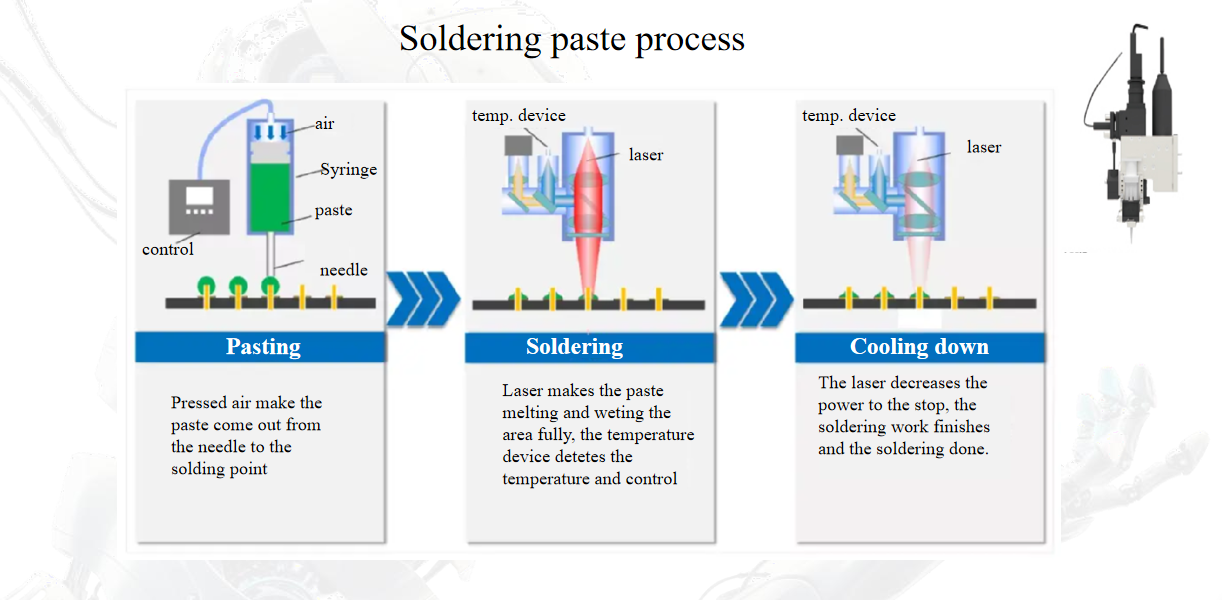
- Solder feed mechanism. Solder wire feeding is the simplest. Solder ball feeding (0.3–1.0 mm balls) with a motorised nozzle and ball-presence sensor costs more; paste dispensing with a jet valve costs more again and needs its own cleaning routine.
- Vision and motion. CCD alignment at ±0.02 mm with a 4-axis gantry is standard in mid-range machines; manual alignment on a benchtop unit saves ₹5–8 lakh but adds an operator dependency.
- Automation and interface. SMEMA conveyor handshake, MES/ traceability logging, barcode reading and post-solder AOI each add cost — AOI alone is typically ₹6–10 lakh.
- Service and spares in India. A local engineer, a stocked spares kit and a documented AMC add to the purchase price but materially reduce downtime cost.
Indicative price bands by machine configuration
| Configuration | Laser source / power | Solder feed | Vision & control | Typical throughput | Indicative price (INR) |
|---|---|---|---|---|---|
| Manual benchtop, single head | Diode / fiber, 10–20 W | Wire or paste, manual load | Pyrometer closed loop, manual alignment | 200–600 joints/hr | ₹8–15 lakh |
| Semi-automatic with CCD | Fiber, 20–30 W | Ball or paste, motorised feed | CCD ±0.02 mm, closed loop, recipe storage | 800–1,500 joints/hr | ₹18–30 lakh |
| Inline automated cell | Fiber, 30–50 W | Ball/paste, auto replenish | CCD + post-solder AOI + SMEMA | 1,500–3,000 joints/hr | ₹35–60 lakh |
| Multi-head / packaging grade | 50–100 W, dual wavelength | Fine ball 0.15–0.3 mm or jetting | High-resolution vision, AOI, traceability | Depends on layout | ₹60 lakh – ₹1.2 crore |
A useful sanity check on any quote: the laser source + motion + vision should account for roughly 55–65% of the machine price. If a quote shows a high total with a modest optical and motion package, the money is sitting in margins or in features you may not need.
Which specification changes your quote the most?
When you compare two offers, ask each supplier to state the following on paper. This is where ₹10–15 lakh of variance usually hides:
- Actual measured spot size at the work plane (0.3–2 mm), not the nominal fiber core diameter.
- Positioning repeatability, quoted as ±mm over 100 cycles — not “high precision.”
- Temperature profile capability: can it hold a 2-second preheat at 120 °C before the reflow pulse? Automotive ECU and sensor assemblies usually need this to avoid thermal shock.
- Nitrogen purge provision. Without N₂, you get oxidation and dark residue on the joint; adding a nozzle and flow controller later is rarely clean.
- Whether AOI is a separate module and whether it is calibrated to IPC-A-610 acceptance criteria for the joint class you build.
- Spare parts list with Indian rupee prices and lead times — laser module, pyrometer, nozzle, feed motor.
Costs beyond the machine price in India
Budget 12–20% on top of the ex-works price for a realistic landed cost:
- Customs duty and IGST on imported units — confirm the HS classification with your CHA before you sign, since the duty treatment differs between soldering and general laser processing equipment.
- Freight, rigging and installation — an inline cell needs a proper foundation check and levelling.
- Utilities — 415 V three-phase supply with a stabiliser, dry compressed air at 5–6 bar, exhaust for flux residue, and for lasers above 50 W, a chiller. Chiller power draw alone is often 1.5–3 kW continuous.
- Consumables — nozzles, solder balls, wire, shields. Nozzle life on a well-run machine typically runs 20,000–50,000 shots; get the supplier to state it.
- AMC — budget 8–10% of machine value per year after warranty.
How to validate a quote before releasing the PO
Do not accept price confirmation as technical confirmation. Send 20–50 real boards or connectors — worst-case thermal mass included — and require:
- A soldering trial with the actual temperature curve logged, showing peak joint temperature within ±10 °C of target across five consecutive units.
- Cross-section or pull test on the trial joints; for automotive work, request the acceptance criteria in writing before the trial starts.
- Common failure symptoms and remedies demonstrated by the supplier: incomplete ball reflow (raise pulse energy or extend dwell), cold joint with dull fillet (verify pyrometer calibration and emissivity setting), solder bridging (reduce paste volume or adjust spot offset), component damage (check for overshoot on the first 100 ms of the pulse).
- A written commitment on installation, operator training and response time for service in India.
FAQ
Is a ₹5–6 lakh laser soldering machine a good entry point?
At that price you are usually looking at a low-power open-loop unit without CCD or closed-loop temperature feedback. It can work for single-joint prototyping on wire or paste, but it will not hold repeatability on production volumes and it lacks the thermal control needed for automotive-grade joints. Budget for ₹8–15 lakh as a realistic minimum for production use.
Does GST and customs duty add significantly to the quoted price?
Yes. IGST applies on top of the landed value, and imported machines also attract basic customs duty. Ask for a landed-cost sheet rather than an ex-works price, and confirm the HS code classification with your customs broker — it is the single most common source of budget overrun.
Can one machine feed both solder ball and solder wire?
Some semi-automatic platforms support a swappable feed module, typically adding ₹2–4 lakh. It is worth it if you run mixed product; it is a maintenance burden if you build one product family. Decide based on your joint mix, not on flexibility for its own sake.
What is the running cost per joint?
For most electronics assemblies the dominant costs are electricity, nitrogen if used, and nozzle replacement — typically a few paise per joint at production volumes. The variable that actually moves your cost per board is first-pass yield, which is why AOI and closed-loop control pay back faster than a lower sticker price.
Send us your board or connector samples, joint count and takt time, and we will return a configured laser soldering proposal with an itemised Indian landed cost and a trial plan you can validate before ordering.