


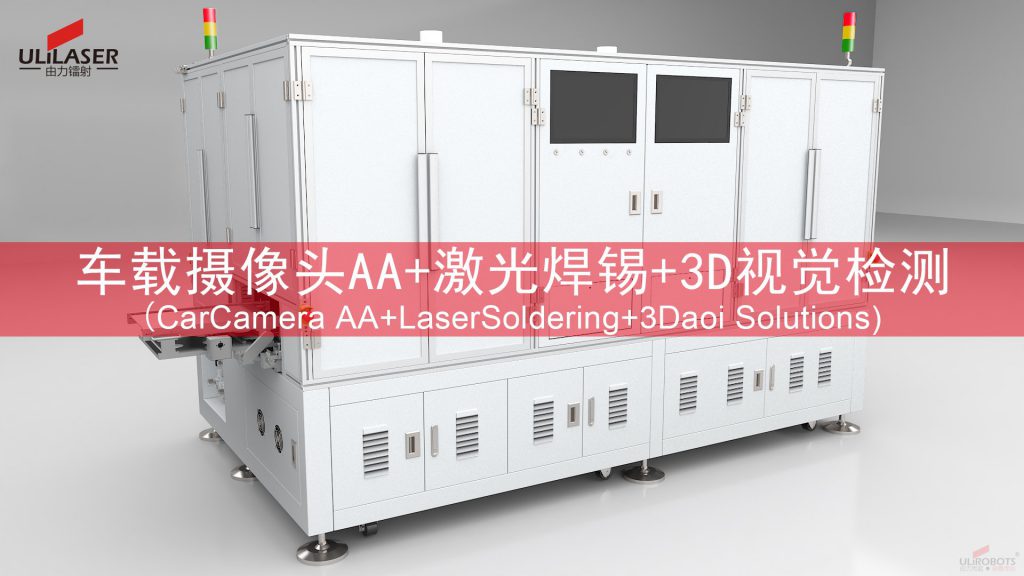
Why laser soldering is taking over automotive camera-module manufacturing — precision, yield and reliability at Tier-1 scale.
Automotive camera modules are among the densest, most thermal-sensitive electronics on any vehicle. As camera count per vehicle climbs and resolution pushes past 17 MP, the soldering step has become a major yield bottleneck. Laser soldering is the technology helping Tier-1s break through.
Three pain points laser soldering solves
1. Dense, high-accuracy joints. Automotive camera PCBs pack thousands of 0402 and 0201 components plus fine-pitch connectors. Laser soldering delivers micron-level positioning with a 0.1 mm spot size — small enough to solder the pads without bridging adjacent pins.
2. Heat-sensitive optics. A camera module’s lens barrel, IR-cut filter and CMOS sensor mount cannot handle the heat of wave or iron soldering. ULiLASER’s closed-loop laser process keeps the heat-affected zone under 0.1 mm, preventing thermal drift while still producing a strong metallurgical joint.
3. Tier-1 reliability requirements. Automotive cameras must survive –40 °C to 85 °C cycling, 500-hour salt-spray and 10-year field life. Laser-soldered joints deliver a projected life of 10+ years / 200 000 km, passing ISO 16750 and most Tier-1 internal specs out of the box.
One integrated platform
ULiLASER’s camera module line combines AA (Active Alignment), precision laser soldering and 3D AOI inspection on one platform. Active alignment sets lens-to-sensor accuracy within 1.5 μm; the laser joints the pads without thermal damage; the 3D AOI inspects every joint before the module moves on. Together they deliver first-pass yield of 98–99.3% for 8 MP+ HDR camera modules.
“Tier-1s do not buy soldering machines — they buy yield, reliability and traceability,” says ULiLASER. “That is exactly what this platform delivers.”