


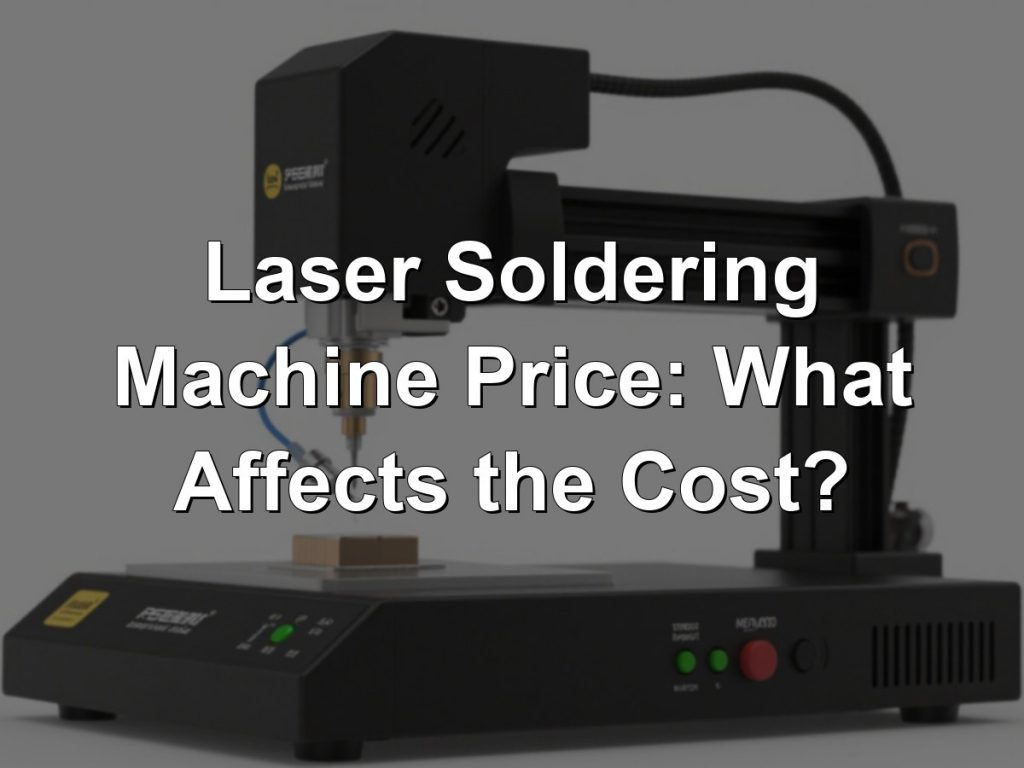
A laser soldering machine typically costs between USD 25,000 and USD 300,000, and the price is set almost entirely by five things: the laser source and optical delivery, the solder feeding method (wire, paste or ball), v…
A laser soldering machine typically costs between USD 25,000 and USD 300,000, and the price is set almost entirely by five things: the laser source and optical delivery, the solder feeding method (wire, paste or ball), vision alignment and closed-loop temperature control, the level of inline automation, and whether post-solder AOI and MES connectivity are included. Two machines with the same footprint can differ by 4–5× in price because one is a benchtop wire-feed unit and the other is a multi-head inline cell with pyrometer feedback, upward-looking camera and integrated AOI. The sections below break down where the money actually goes, so you can match the specification to your joint size, pitch and throughput instead of over- or under-buying.
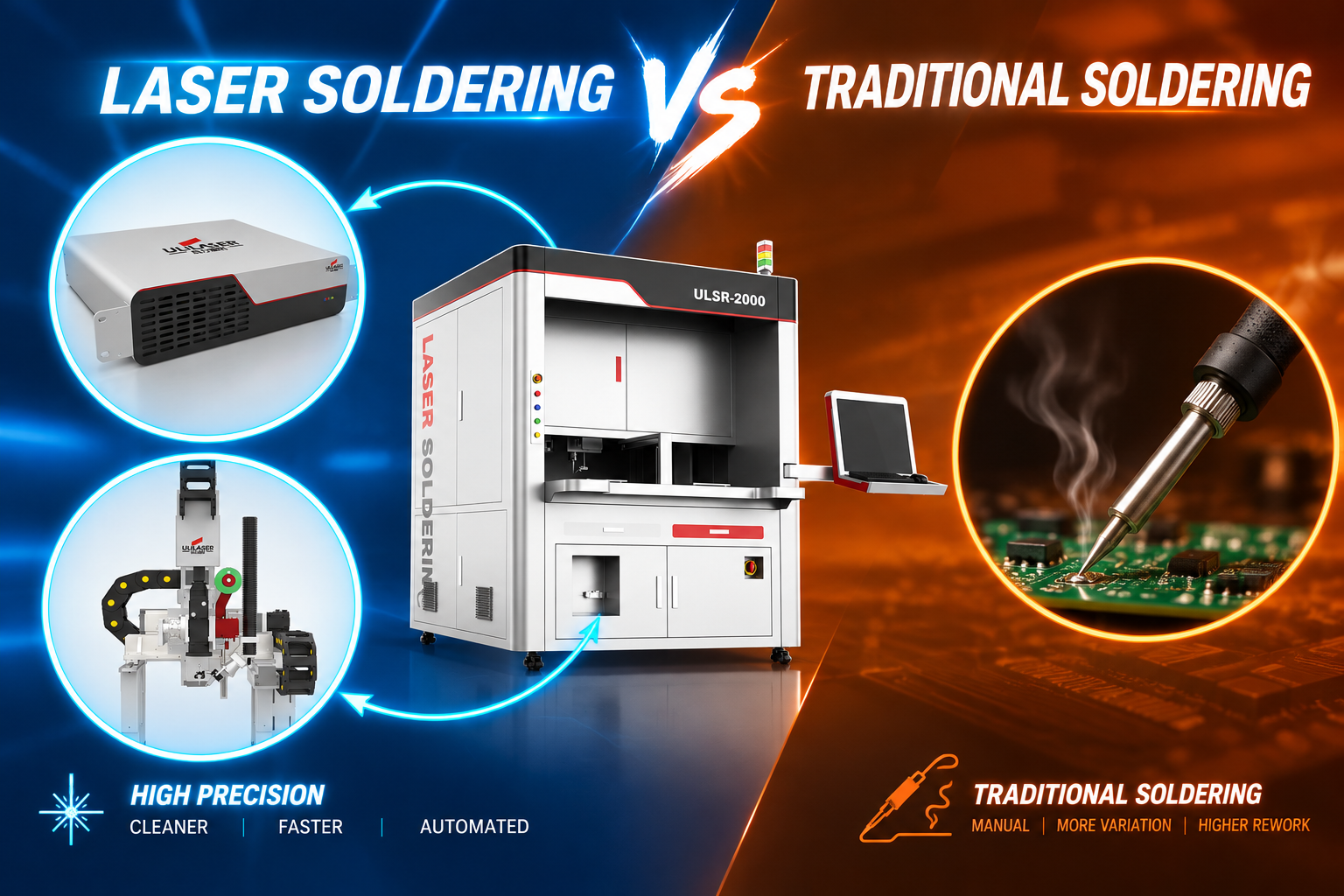
What Is the Typical Price Range for a Laser Soldering Machine?
Quoted configurations in electronics manufacturing generally fall into three tiers. The tier is defined less by laser power than by how much of the process is automated and verified.
| Configuration tier | Typical price band (USD) | What is normally included | Typical fit |
|---|---|---|---|
| Benchtop / semi-automatic | 25,000 – 60,000 | Single diode laser head, manual or semi-auto load, wire or paste feed, basic camera for programming, open-loop power/time profile | Prototyping, low-volume sensor and connector assemblies, R&D validation |
| Standalone automatic cell | 60,000 – 130,000 | CCD vision alignment, closed-loop pyrometer control, automatic solder feed, servo gantry, recipe management, SMEMA interface | Automotive sensor/ECU boards, optical module housings, medical device electronics, medium volume |
| Inline multi-head system | 130,000 – 300,000+ | 2–4 laser heads or beam-split multi-spot, linear-motor stage, integrated post-solder AOI, MES/SECS-GEM traceability, loader/unloader integration | High-volume automotive electronics, power module and semiconductor packaging lines |
Treat these as planning bands, not quotations. A single option — for example solder ball jetting instead of wire feed, or an upward-looking camera for through-hole and BGA — can move a quote from one tier toward the next.
Which Laser Source and Optical Configuration Drive the Cost Most?
The laser source is usually the single largest line item, followed by the beam delivery optics. The right choice depends on joint size, pitch, and how much heat the surrounding components can tolerate.
| Source / delivery option | Typical spot or feature size | Relative cost impact | When it is worth paying for |
|---|---|---|---|
| Diode laser, 808/940/980 nm, 30–60 W, fixed head | 0.3 – 1.5 mm spot | Baseline (lowest) | Discrete joints, pads ≥0.4 mm pitch, wire and paste soldering |
| Diode laser, 100–200 W with fiber delivery | 0.5 – 3 mm spot | +20 – 40% | Large thermal mass, ground planes, high-throughput single-spot joints |
| Single-mode fiber laser, 1070 nm, 30–100 W | 0.1 – 0.4 mm spot | +30 – 60% | Fine-pitch connectors, 0.2–0.3 mm pads, heat-sensitive neighbours |
| Galvo scanning head instead of gantry motion | Fast repositioning, 1–3 ms per jump | +15 – 30% | Many small joints per part, short cycle-time targets |
| Multi-head or diffractive multi-spot | 2–8 parallel joints | +40 – 高度 | Connector rows, shielded housings, throughput-bound lines |
Two specification traps here. First, more watts is not automatically better: an oversized spot heats the whole assembly and can drive warp-related defects, so a 40 W source with the correct spot can outperform a 150 W source on fine pitch. Second, wavelength must match the absorptivity of your solder and flux system — a source that suits one paste may need higher energy density for another, which changes both cycle time and ownership cost.
How Much Do Solder Feeding Method, Vision and Closed-Loop Control Add?
These three items decide whether the machine can hold a repeatable joint without an operator watching it, and they are where most specification errors happen.
- Solder feeding. Wire feeding (0.3–1.2 mm) is the lowest-cost option and simplest to maintain. Paste dispensing via auger or time-pressure valve sits in the middle and gives better control of deposit volume on small pads. Solder ball jetting or preform placement is the most expensive option — typically adding 25,000–60,000 USD — but it is often the only practical route below 0.3 mm pitch and for controlled stand-off in semiconductor packaging.
- Vision alignment. Basic pattern recognition adds roughly 8,000–15,000 USD. A high-resolution telecentric camera with coaxial illumination, achieving ±10 µm placement versus ±25 µm, adds in the region of 15,000–30,000 USD. An upward-looking camera for ball-grid and through-hole joints is a further option.
- Closed-loop temperature control. A pyrometer with real-time PID feedback and emissivity compensation adds about 5,000–15,000 USD. On thin boards, flex assemblies and packages with tight Tg margins, this is not optional: it is what prevents cold joints on one part and scorched flux on the next.
- Flux management. Separate flux dispensing plus the nitrogen shield hardware typically adds 5,000–12,000 USD, and the nitrogen itself becomes a running cost.
What Do Automation, AOI and Software Add — and What Are the Ongoing Costs?
Inline integration is a project cost, not just a machine option. SMEMA interface, loader/unloader compatibility, custom fixtures and safety guarding commonly add 20,000–50,000 USD. Integrated post-solder AOI adds 25,000–60,000 USD depending on camera resolution and defect algorithms. MES or SECS-GEM connectivity, traceability logging and additional recipe licences add a few thousand per seat, but they are frequently a hard requirement for automotive electronics suppliers.
Budget separately for the ongoing side, which is often underestimated:
- Tooling and fixtures: 2,000–10,000 USD per product family, sometimes per variant.
- Consumables: nozzles at 200–800 USD each, protective shield glass, wire-feed tips, dispenser valves. Plan on 5–10% of machine price per year.
- Nitrogen: 15–30 L/min per head during production.
- Calibration, pyrometer re-verification and engineer training, typically one to two service visits in year one.
How Do You Specify a Machine Without Paying for Unused Capability?
Start from the joint, not the brochure. Define the smallest pad and pitch on your roadmap for the next three years, the thermal mass behind the joint, the required cycle time, and the inspection standard you must meet. Then set acceptance criteria in the purchase order so that price and performance are locked together.
Practical acceptance checks to write into the specification:
- Joint temperature repeatability within ±5 °C across 30 consecutive parts, measured at the solder interface.
- Placement repeatability within ±0.01 mm over a 100-part run.
- Fillet geometry and wetting per IPC-A-610 / J-STD-001 class requirements, verified by cross-section on the first article.
- Void rate under thermal pads, verified by X-ray, with an agreed limit.
- Cycle time per joint and per part, measured on your actual product, not a demo coupon.
Common failure symptoms and where to look first: cold or incomplete joints usually point to insufficient energy density, wrong spot size, expired flux or a drifting pyrometer reading; solder spatter indicates an over-fast ramp or moisture in the paste; head-in-pillow on area arrays suggests package warp and insufficient soak time, which often needs a longer, lower-power profile rather than more power. Ask the supplier to run your worst-case board during acceptance — that single test resolves most price-versus-capability arguments before the purchase order is signed.
FAQ
Does a higher laser power mean a higher machine price?
Not by itself. Power is one line item among many. A 40 W fine-spot system with vision and closed-loop control often costs more than a 150 W open-loop unit with a large spot, because the optics, feedback and alignment hardware carry more of the price than the source rating.
Can I start with a benchtop laser soldering machine and upgrade to inline later?
Sometimes, but check the controller, fieldbus and frame design before you buy. Machines built with an SMEMA-ready frame and an expandable motion controller can be integrated into a line later; entry-level benches usually cannot, and retrofitting costs more than buying the mid-tier unit initially.
Is integrated AOI worth the extra cost?
If you ship to automotive or medical customers, usually yes — it eliminates a separate inspection station and gives per-joint traceability. For low-volume or prototype work with highly visual inspection by an operator, it is often money better spent on better closed-loop temperature control.
Why do two quotes for an apparently similar machine differ by 2×?
Compare the laser source and beam delivery, the feeding method, whether temperature control is genuinely closed-loop, camera resolution, motion platform class, and what is excluded — fixtures, installation, training, spare kits and warranty terms. A lower quote frequently omits the nitrogen kit, fixtures and commissioning.
What is the typical lead time and how does it affect price?
Standard configurations usually run 8–16 weeks; custom fixtures, multi-head optics or additional AOI algorithms extend that. Expedited delivery is often quoted as a premium, so build the schedule into the negotiation rather than paying for it later.
If you share your pad size, pitch, board thermal mass and target cycle time, we can map those requirements to a specific configuration and give you a cost breakdown line by line.