


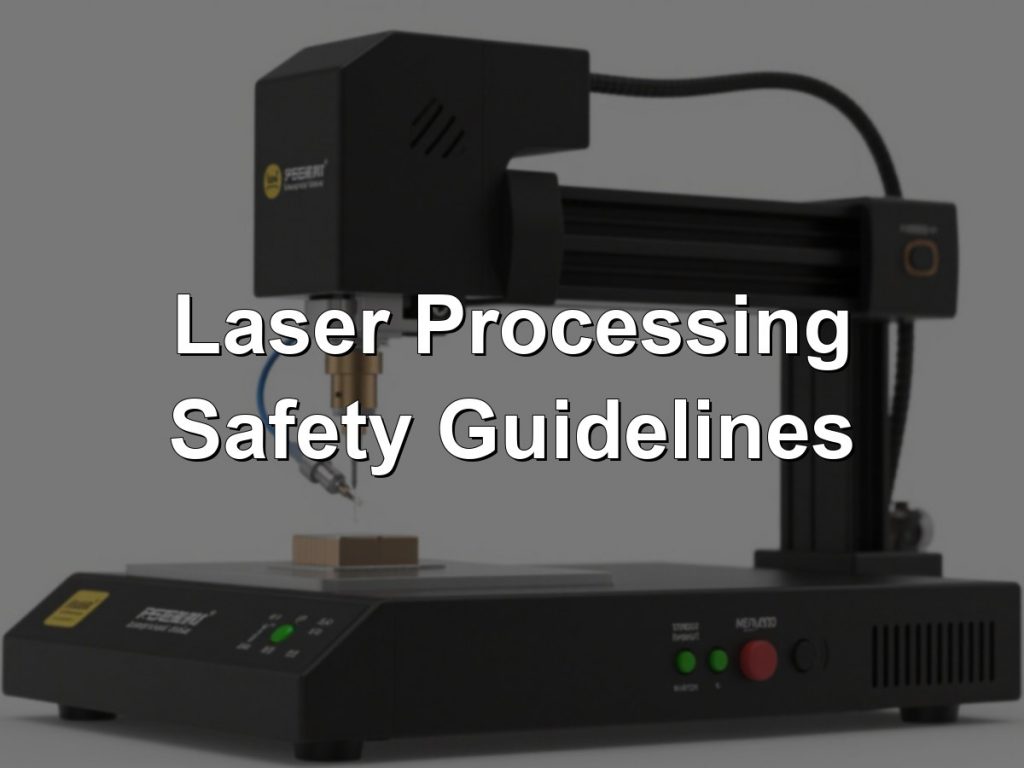
Laser processing safety guidelines for laser soldering come down to three layers of control: engineering containment (a light-tight enclosure with fail-safe interlocks that turns a Class 4 beam into a Class 1 laser produ…
Laser processing safety guidelines for laser soldering come down to three layers of control: engineering containment (a light-tight enclosure with fail-safe interlocks that turns a Class 4 beam into a Class 1 laser product in normal operation), administrative control (a named laser safety officer, written SOPs, training records and signage) and PPE (wavelength-matched eyewear for service and alignment only). The critical fact for electronics manufacturing is that soldering lasers are typically 30–200 W diode sources at 915–980 nm — invisible near-infrared, where the eye has no blink reflex and no visible beam to warn of a stray reflection. Containment, not goggles, is therefore the primary safeguard, and every other measure on the floor is built around keeping that enclosure closed.
What laser class is a laser soldering system — and what does that mean on the line?
A laser soldering head is a Class 4 source: at 915 nm or 980 nm, anything above 500 mW continuous is Class 4 under IEC 60825-1, and 30–200 W is two orders of magnitude above that threshold. Once the head is mounted inside a fixed, interlocked enclosure with no accessible beam path, the complete machine is classified as a Class 1 laser product during normal operation — the operator can work at the load/unload port without eyewear. Two configurations are sold, and the difference matters at procurement:
- Fully enclosed inline module — Class 1 in operation; interlocks, shutter and extraction are integrated. This is the standard choice for a production line shared with other operators.
- Open bench-top head — Class 4 at the workstation. Acceptable only inside a separately assessed guarded cell, with an LSO-approved written procedure and controls for the whole room.
Note that laser soldering is a filler-metal reflow at a 200–260 °C joint temperature, not fusion welding of the base metal. The hazard profile is a small, highly concentrated near-IR heat source with a strong specular reflection off solder balls, gold-plated pads and polished fixtures — not a multi-kilowatt welding plume. Ask the supplier for the laser classification label, the IEC 60825-1 test report and the nominal ocular hazard distance (NOHD) figure: for a 100 W Class 4 source the NOHD runs to tens of metres, which is exactly why open-beam operation is impractical on a factory floor.
Which engineering controls must be in place before the first joint is made?
| Control | Typical specification | Acceptance check |
|---|---|---|
| Protective housing | Tool-removable panels, no sight-line to the beam or to specular targets | Visual inspection under power-off; no gaps > the beam divergence path |
| Interlock system | Fail-safe (opening circuit = beam off), redundant for the main door, non-defeatable in production | Open each aperture while firing a test pulse; emission must stop within the specified time |
| Service interlock | Defeatable only with a key or tool, with a visible/audible warning that the machine is no longer Class 1 | Verify warning beacon and label switch-over during maintenance |
| Key or password control | Prevents unauthorised firing; key removed when the machine is idle | Attempt start without key — must fail |
| Emission warning | 1–3 s audible/visual pre-fire delay, indicator visible from the load port | Time the delay; confirm lamp/buzzer function |
| Emergency stop | Within reach of every operator position; kills beam, motion and feeder | Press during a cycle; confirm total stop |
| Beam delivery | Fiber or enclosed optics, minimum bend radius respected, no exposed collimator | Inspect fiber jacket for kinks and connector for contamination at every changeover |
Also guard the motion: the gantry or XY stage moving a 30–200 W head at speed is a mechanical crush and pinch hazard independent of the beam. Light curtains and a two-hand or foot-pedal start are common on manual load stations.
How do you specify laser safety eyewear for near-infrared soldering?
Eyewear is a service and alignment control, not a production control. Filter eyewear must be marked with the wavelength and optical density (OD) it was certified for — a generic “laser goggles” label is not sufficient. OD is calculated as log₁₀ (exposure ÷ maximum permissible exposure) at the specific wavelength, so a filter rated for 1064 nm may be nearly useless at 915 nm.
| Wavelength band | Typical OD required (Class 4, alignment) | Visible light transmission | When worn |
|---|---|---|---|
| 808–830 nm | OD 5–7 | Low–moderate | Fiber and optics service, open-beam alignment |
| 915–980 nm | OD 5–7 | Moderate; a faint red aiming beam must remain visible | Service, alignment at reduced power, interlock defeat |
| 1064 nm (Nd:YAG) | OD 6–7 | Moderate | Legacy systems only |
Practical rules: align at the lowest power that produces a visible result, never at full process power; check the filter for cracks and frame fit every six months; and keep a dedicated pair per machine rather than relying on shared eyewear of unknown rating. Eyewear does not protect against the burn hazard from a hot nozzle, so heat-resistant gloves are a separate item.
Which non-beam hazards should the guideline cover?
- Flux fume. Rosin-based fluxes are a recognised cause of occupational asthma. Extract at the joint, not at the cabinet roof: aim for 0.5–1.0 m/s capture velocity at the fume source, typically 100–200 m³/h per soldering head. Use HEPA plus activated carbon, and do not recirculate filtered air into the room unless the filter is rated for it.
- Thermal and fire. Nozzle tips and the joint area reach 240–260 °C. Keep paper, tape, plastic fixtures and solvent wipes out of the cell; a small nitrogen purge (if used) raises the smoulder risk of paper debris.
- Solder balls and debris. Feeder jams can eject 0.2–0.8 mm spheres. Wear safety glasses when clearing a jam, and clean the catch tray at each shift change.
- ESD. Grounded wrist straps and ionisers belong in the same SOP — the laser head and CCD alignment camera are both ESD-sensitive assemblies.
- Electrical. Lockout/tagout before opening the cabinet; allow the capacitor bank to discharge per the manufacturer’s stated interval.
What does a workable inspection schedule look like?
| Frequency | Checks | Record |
|---|---|---|
| Daily (start of shift) | Enclosure panels and windows intact; warning lamp/buzzer; key present; extraction running; ESD strap tested | Signed checklist |
| Monthly | Interlock test on every aperture; E-stop test; eyewear inspection; fume filter differential pressure | LSO countersign |
| Annual | Full laser safety audit against IEC 60825-1 / EN ISO 11553-1 and local regulation; re-measure enclosure leakage if the head or optics were changed; refresh training | Audit report retained |
| After any service | Interlock restoration, label verification, warning system test, alignment eyewear check | Return-to-service sign-off |
Two failure symptoms worth training for: a machine that fires with a panel open (interlock defeated or bypassed — stop production and lock out, do not “finish the batch”), and a warning beacon that stays lit after the cycle ends (shutter stuck open — treat as an open Class 4 beam).
FAQ
Do operators need laser eyewear inside a Class 1 enclosure?
No, provided every interlock has been verified within the last month and the enclosure has no open sight-line. Eyewear is required the moment an interlock is defeated, a panel is removed, or alignment is performed — the machine is a Class 4 product at that point.
What optical density do I need for a 980 nm soldering laser?
For alignment and service on a Class 4 head, OD 5–7 at 915–980 nm is typical. The exact figure comes from the MPE calculation in the supplier’s safety report; insist the eyewear is marked with both the wavelength and the OD, and verify the filter still passes the aiming beam.
Can we run the machine with the fume extractor off?
No. Interlock the extraction to the laser enable if the process uses rosin-based flux — running without extraction exposes operators to colophony fume at the exact point of generation and contaminates the protective optics, which then absorb laser energy and degrade.
Who is allowed to open the enclosure?
A trained technician working under the LSO’s written procedure, with lockout/tagout applied, the key removed and the area barricaded with a Class 4 warning sign. Anyone else, including line supervisors, should treat the cabinet as sealed.
If you are specifying a laser soldering cell and need the classification documentation, interlock specification or extraction requirements for your line, send us your joint geometry and throughput and we will walk you through the safety-relevant configuration.