


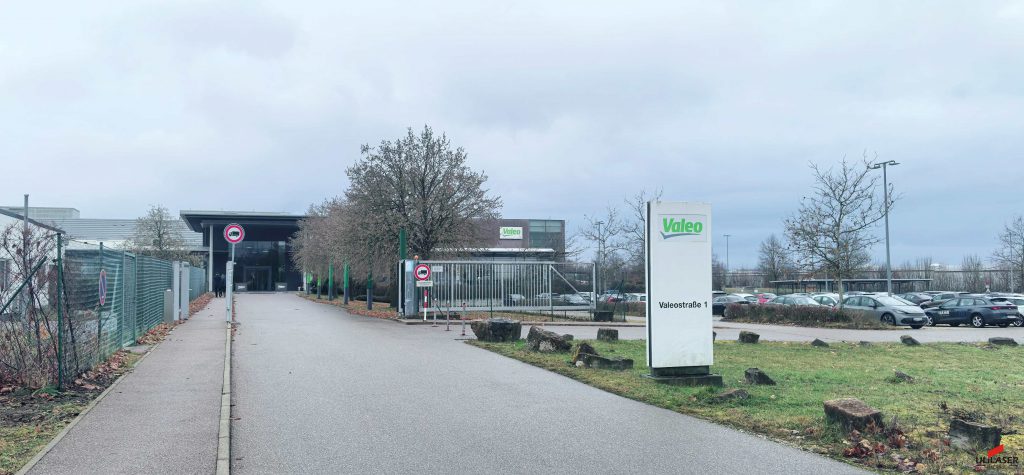
VALEO automotive camera leaders visit ULiLASER in Shanghai after an initial meeting at Electronica Munich, validating the AA + Laser + 3D AOI platform on real production lines.
The road from Electronica Munich to ULiLASER’s Shanghai factory just got a lot shorter. After an initial meeting on the show floor, VALEO automotive camera leaders travelled to Shanghai in December for a three-day technical exchange — the latest step in what is quickly becoming a deep partnership.
How it started
ULiLASER’s booth at Electronica Munich showcased its integrated AA (Active Alignment) + precision laser soldering + 3D AOI platform — a full-loop solution from lens assembly through welding and inspection. VALEO’s automotive camera project leaders recognised in it exactly what they had been hunting for: a single platform that closes the loop on camera-module alignment, soldering and quality, and that could match VALEO’s strict automotive-grade requirements.
Following the show, ULiLASER was invited to VALEO’s German HQ. Over two days of technical exchange the two teams covered implementation details, integration paths and industrialisation strategies — and VALEO invited ULiLASER to open its factory doors.
Inside the Shanghai factory
On 17 December, the VALEO team walked ULiLASER’s production lines and R&D centre. On the camera-module line, they watched a high-frame-rate vision system align lens to sensor within micrometres, followed by a customised laser soldering station that keeps the heat-affected zone under 0.1 mm — protecting delicate optics from thermal damage. The 3D AOI station that comes right after can pinpoint lens-assembly deviation and soldering defects to 0.01 pixel, with every measurement traceable.
High-pixel, high-dynamic-range challenges
Across the table in the technical deep-dive, VALEO’s PL-IP owner highlighted the manufacturing bottleneck emerging with L4-level autonomous driving: next-gen automotive cameras already exceed 17 MP, and high-dynamic-range (HDR) imaging plus harsh-environment capability are becoming non-negotiable. ULiLASER’s response was concrete — the company has worked in parallel with sensor vendors on customised laser processes for 8–18 MP mixed glass-plastic lenses, with closed-loop laser-energy control enabling stress-free soldering. A proprietary optical darkroom inspection system catches lens distortion and imaging bias at 0.01-pixel accuracy.
What happens next
Both teams have agreed to set up a dedicated liaison group covering technical-parameter alignment, sample testing and capacity planning. What started as a booth conversation has matured into an industrial partnership that covers R&D, IP co-development and volume production — a template for how global Tier-1s and specialist equipment suppliers can move from first contact to shop floor.